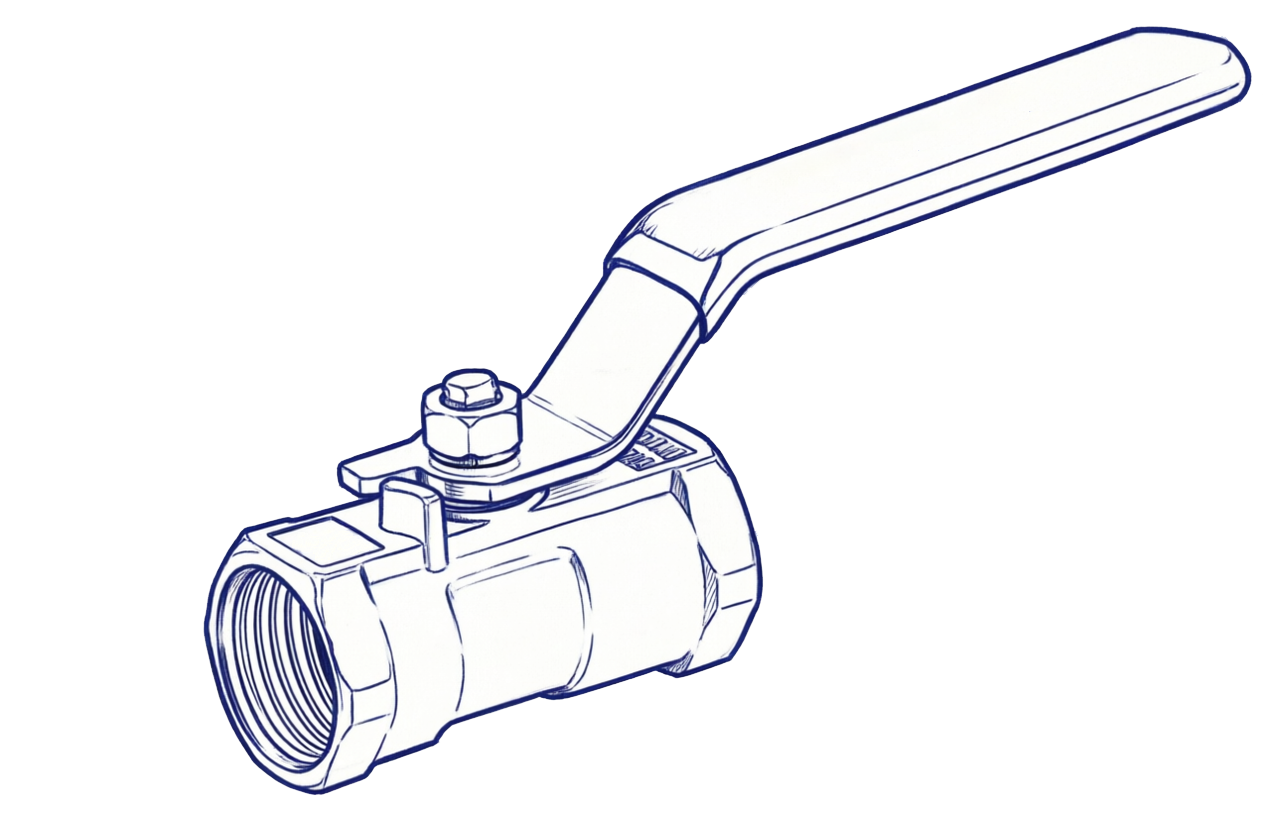
For industrial and hygienic process equipment, the important specification is not simply “three way.” The actual flow pattern, port orientation, connection standard, materials, seals, and operating conditions determine whether the valve is appropriate for a particular installation.
This distinction is particularly important in B2B purchasing. A product photograph may show a three-port body, but it does not tell the buyer whether the internal configuration is L-port or T-port, how the ports communicate in each handle position, or what thread standard is used. The selection should therefore begin with the process flow requirement and end with a model-specific technical review.
A three way ball valve is a quarter-turn rotary valve with three process connections. A specially drilled ball rotates inside the valve body and changes which ports are connected.
The valve can therefore perform flow-routing duties such as selecting between two destinations, diverting a stream, combining streams, or creating a defined bypass arrangement. The exact function depends on the internal ball drilling and the way the valve is installed in the piping system.
“Thread” describes the end connection. A threaded three way ball valve may use a standard such as NPT, while other versions of a similar valve family may use clamp, welded, or other connections.
This distinction is useful when evaluating supplier catalogues. Three-way function and connection type are separate parts of the specification, and both should be stated clearly in an RFQ or purchase order.
A two-way ball valve normally provides straightforward line isolation: the passage is open or closed. A three-way ball valve adds a third connection, allowing the operator to change the relationship between multiple flow paths.
For example, a process feed may need to be directed to Tank A during one production step and Tank B during another. In another arrangement, two streams may need to reach a common outlet. A three-way valve can be considered for these routing tasks when its internal flow pattern matches the required process sequence.
However, the presence of three ports does not guarantee a particular flow function. The internal drilling of the ball determines which ports communicate in each operating position. This is why selecting a valve by body shape, nominal size, or the words “three way” alone can result in an incorrect specification.
A better method is to define the required flow positions first, then match the valve's port diagram to the process flow diagram.
The terms L-port and T-port refer to the geometry of the passage drilled through the valve ball.
An L-port configuration generally connects the common port with one of the other ports at a time. This makes it suitable for applications where a stream needs to be switched or diverted between two routes.
A T-port configuration provides a different set of possible connections. In a suitable position, the three ports can communicate, which can support mixing, splitting, or other multi-path arrangements.
The exact result depends on the manufacturer's port numbering, ball drilling, handle orientation, and permitted operating positions. For this reason, a professional specification should request the manufacturer's flow-path or port-position diagram rather than relying only on the words “L-port” or “T-port.”
A T-port should also not automatically be interpreted as a precision 50/50 flow divider. Actual flow distribution is affected by the resistance of the connected pipework and downstream equipment. Similarly, a three-way ball valve should not automatically be treated as a device capable of completely isolating all three ports simultaneously.
For a threaded three way ball valve, the thread standard is part of the dimensional interface between the valve and the piping.
ASME B1.20.1 covers general-purpose inch pipe threads including NPT and related thread forms. When a project specifies NPT, the valve connection should be checked against the required nominal size and thread form. A similar-looking connection using another thread system should not be assumed to be interchangeable.
This is especially important in international procurement, where suppliers and buyers may use different connection terminology. A purchase specification that simply says “threaded” leaves too much room for interpretation.
The practical approach is to state the thread standard explicitly—for example, NPT—together with the nominal connection size. If the existing piping uses another standard, the supplier should confirm compatibility before production.
Several industry standards can be useful when a buyer is reviewing a ball valve specification, but each standard has a different purpose.
MSS SP-110 covers metal ball valves with threaded and several other end connections, including full, regular, and reduced port designs. It is particularly relevant when a project involves threaded general-service ball valves.
ASME B16.34 addresses valves with flanged, threaded, and welding ends and includes requirements related to pressure-temperature ratings, dimensions, materials, testing, and marking.
ISO 5208 focuses on pressure testing of metallic industrial valves. It addresses testing used to establish pressure-boundary integrity and closure tightness.
These standards should be used as technical references rather than as generic claims of compliance. A valve manufacturer's statement that a product is “designed according to” or “tested according to” a standard is not automatically equivalent to certification or full conformity to every provision. The applicable edition, product scope, and project requirements should always be confirmed.
For process applications, the body material is only one part of the wetted-material specification. The ball, stem, seats, gaskets, and other components exposed to the medium may also affect chemical compatibility, temperature capability, cleanability, and service life.
Likemetals' published three-way ball valve information lists 304 and 316L stainless steel options and gasket choices including silicone, EPDM, NBR, and FPM. The product information also lists several external surface finishes.
For food, beverage, dairy, pharmaceutical, and other hygienic applications, the design should be evaluated against the actual process requirements rather than relying on the word “sanitary” alone. EHEDG Guideline 14 specifically addresses requirements for valves used in hygienic and aseptic processes, including considerations related to materials, drainability, microbial impermeability, and valve-specific hygienic design.
In practice, buyers should confirm the product-contact materials, gasket compatibility, cleaning method, surface requirements, drainage characteristics, and any required hygienic certification or documentation.
The Likemetals product page presents a stainless steel three-way ball valve with a full-bore design and describes applications in food, beverage, chemical, and pharmaceutical industries, including services involving viscous liquids or liquids containing particles.
The published configuration information includes Tri-clamp, NPT, weld, and pin connection options; 304/316L material choices; silicone, EPDM, NBR, and FPM gasket options; and matte, mirror-polished, and sand-blasted external finishes.
These published details establish the product family's available configuration range. They should not be expanded into specifications that are not stated on the product page. In particular, the buyer should request the exact port diagram, pressure-temperature limits, nominal size, seat specification, and project documentation for the selected model.
For the latest product information, buyers can refer directly to the Likemetals product pages listed in the Related Examples section below.
A clear RFQ should describe the process requirement before asking the supplier to recommend a model.
This level of detail gives the manufacturer enough information to quote the correct configuration instead of quoting a visually similar three-port valve that may have a different internal flow pattern.
The most common mistake is treating every three-port ball valve as functionally equivalent. The internal ball drilling must match the intended flow sequence.
Another common mistake is writing “threaded connection” without specifying the thread standard. NPT, BSP-family threads, and other systems should be identified explicitly.
A third mistake is specifying only the body material. In a process application, the seat and gasket materials may be just as important for compatibility and service life.
Finally, buyers sometimes request a pressure rating or certification without defining the applicable standard. A technically meaningful requirement should identify the relevant standard, operating conditions, test requirements, and documentation needed for the project.
A professional valve specification therefore connects the flow diagram, mechanical interface, materials, operating conditions, and quality documents rather than relying on a single product name.
A three way thread ball valve is best understood as a flow-routing device whose suitability depends on the relationship between its internal bore, port arrangement, connection standard, materials, seals, and the surrounding process system.
For B2B buyers, the most reliable selection process starts with the required flow logic and then verifies the manufacturer's port diagram, connection standard, size, materials, pressure and temperature limits, hygienic requirements, and documentation.
Likemetals' published three-way ball valve range provides several configuration options, including 304/316L stainless steel, multiple connection types, gasket choices, and external surface finishes. These published details are a useful starting point, while the final configuration should be confirmed against the specific project requirements before production.
Q: What is a three way thread ball valve used for?
A: It is used to route process media between three connected flow paths. Depending on the internal bore, it can support diverting, selecting, mixing, splitting, or bypass arrangements.
Q: What is the difference between L-port and T-port?
A: L-port and T-port describe the internal passage through the ball. L-port configurations are commonly used for switching between two paths, while T-port configurations provide additional three-port routing possibilities. The manufacturer's flow diagram should be checked for the exact operating positions.
Q: Are NPT and BSP threads interchangeable?
A: No. They are different thread systems. The thread standard and nominal size should be confirmed against the mating piping or fitting.
Q: Does a three-way ball valve automatically provide complete shutoff?
A: No. The available isolation positions depend on the internal ball design and port arrangement. If a process requires simultaneous isolation of multiple lines, additional isolation valves may be necessary.
Q: What information should I send when requesting a quotation?
A: Provide the required flow function, port pattern and orientation, connection standard, size, material, seat and gasket materials, medium, pressure, temperature, surface requirements, and required technical or quality documents.
ASME B1.20.1 – Pipe Threads, General Purpose, Inch — ASME's reference for NPT and related general-purpose inch pipe threads; useful for the threaded-connection section. View official reference
MSS SP-110 – Ball Valves: Threaded, Socket-Welding, Solder Joint, Grooved and Flared Ends — Industry standard practice directly relevant to metal ball valves with threaded and other end connections. View official reference
ASME B16.34 – Valves: Flanged, Threaded, and Welding End — Reference for valve pressure-temperature ratings, dimensions, materials, testing, and marking. View official reference
ISO 5208 – Industrial Valves: Pressure Testing of Metallic Valves — International reference for pressure-boundary and closure-tightness testing of metallic industrial valves. View official reference
EHEDG Guideline 14 – Requirements for Valves in Hygienic and Aseptic Processes — Professional hygienic-design reference for valves used in food and aseptic processing environments. View official reference
EHEDG Guideline 8 – Hygienic Design Principles — Broader hygienic-design reference covering risk-based design principles for food-processing equipment. View official reference
Likemetals – Quick Install Three Way Ball Valve